Whales: Giants of the Ocean

Whales: Giants of the Ocean

Whales are among the largest and most remarkable animals on Earth. These marine mammals live in oceans around the world, from warm tropical waters to the cold seas surrounding the poles.

Life Beneath the Surface

Although whales spend their lives in water, they breathe air through blowholes located on top of their heads. They must regularly return to the surface to breathe before diving again in search of food or traveling through the ocean.

Whales are warm-blooded, give birth to live young, and nurse their calves with milk. A thick layer of fat called blubber helps protect them from cold water and stores energy during long migrations.

Two Main Groups

Whales are generally divided into baleen whales and toothed whales. Baleen whales filter small animals from the water using flexible plates inside their mouths. This group includes blue whales, humpback whales, and gray whales.

Toothed whales use teeth to catch fish, squid, and other prey. Many of them also use echolocation, producing sounds and listening for returning echoes to understand their surroundings. Sperm whales, belugas, and orcas belong to this group.

The Blue Whale

The blue whale is the largest known animal to have ever lived. An adult can grow longer than a city bus and weigh well over one hundred tonnes. Despite its enormous size, it feeds mainly on tiny crustaceans called krill.

Communication and Migration

Whales communicate using clicks, whistles, pulses, and complex songs. Some sounds can travel across great distances underwater. Humpback whales are especially famous for their long, patterned songs.

Many species migrate thousands of kilometres each year. They often feed in cold, nutrient-rich waters before traveling to warmer regions where they mate and give birth.

Protecting Whales

Commercial hunting once caused severe declines in many whale populations. Today, whales also face threats from fishing gear, ship collisions, underwater noise, pollution, and changes to ocean ecosystems.

Conservation programs, safer fishing practices, protected habitats, and international cooperation can help whale populations recover. Protecting whales also supports healthier oceans because these animals play an important role in marine food webs and nutrient cycles.

Columbia Winery, Seattle, Washington

One of the best dinner that I had at the Society of Wine Educators (SWE) Conference in Seattle, WA was at the Columbia Winery.
2014-08-12 18.27.14

2014-08-12 18.25.39

2014-08-12 18.25.32

2014-08-12 18.24.55

2014-08-12 18.24.34

2014-08-12 18.24.33

2014-08-12 18.24.16

What an amazing winery, modern and yet quaint with a formal dinning room and a spectacular wine barrel room. The night started out with a visit in their barrel room, a live jazz band, and passing h’orderves which are paired with their wines. Followed by a multicourse meal which also pair with their wines. I have to say that the food was amazing and their food and wine pairing is perfect. Each dish flavor were enhanced by the wine and vice verse with the wines. I have to say that the people at Columbia Winery left me with a very memorable evening of food and wine.
2014-08-12 19.00.25

2014-08-12 19.00.19

2014-08-12 18.29.04

2014-08-12 18.29.01

2014-08-12 18.28.51

2014-08-12 18.28.31

2014-08-12 18.28.22

2014-08-12 18.28.17

2014-08-12 18.28.11

2014-08-12 18.28.08

2014-08-12 18.27.33

2014-08-12 18.27.23

At the dinner I had the chance to see two of my most favorite wine instructors, both of whom are very knowledgeable and very passionate about passing on their wine knowledge. I have learned a lot from them over the time that I have known them. David Glancy his website is http://sanfranciscowineschool.com/ and Miss Jane Nickles, “The Bubbly Professor” her website is http://bubblyprofessor.com/
2014-08-12 19.58.18

-que ©2014

38th Annual SWE Conference

The 38th Annual Society of Wine Educators (SWE) Conference in Seattle, Washington.2014-08-11 07.33.01

What an amazing conference for everyone who loves to drink and learn more about wines. This conference is not just all about drinking there are classes which are geared toward furthering wine education. The day starts out at 8:00 a.m. to 7:00 p.m. filled with classes that are taught by Certified Wine Educator (CWE) and Master Sommelier (MS) throughout the various conference rooms. Although, we do get to taste a lot of wines, most of which are too expensive to purchase for personal consumption. The purpose is to taste these wines, so you need to spit it out. However, given the price of some of these wines I would not spit but rather drink it. If you do what I do, which is drinking, keep in mind that there will be a lot of wines so take your time and remember not to get drunk. The conference fills up quickly so you have to jump right on to their website and register. Make sure that you also register for your classes because these fill up quickly too. If you wait a day or two before registering for your classes be prepared to find out that most of them will be full.

One of the classes that I highly recommend is the CWE Preview class conducted by Miss Jane Nickles, “The Bubbly Professor” her website http://bubblyprofessor.com/2014-08-11 12.32.01

Some of the wines that was tasted at the conference.
2014-08-11 15.29.45

2014-08-12 09.01.44

-que ©2014

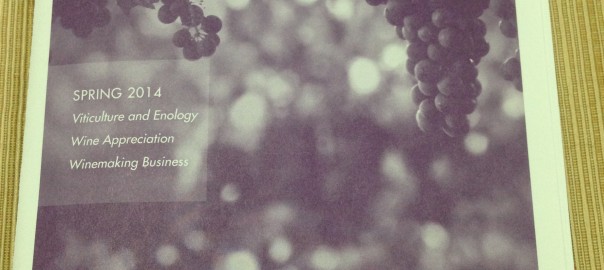
On Wine: Great classes offer at UC Davis Extension if you are a wine enthusiast.

Introduction to Sensory Evaluation of Wine: Novice oenophiles, enhancing your critical tasting ability and learn basic aspects of sensory evaluation often overlooked in most wine tastings. Exploring the origins of desirable and undesirable flavors of wine and the stylistic contributions of winemaking techniques. Emphasis is placed on correct use of wine descriptive terminology.

Descriptive Analysis of White and Red Table Wines: Smell is the dominant sense humans use to detect overall flavor in wine, and aromatics are responsible for the majority of wine flavor. By further training your sense of smell, you can graduate from simply recording vague impressions of wine to registering more precise analytical descriptive responses. This class presents dozens of white and red wine reference standards to enable you to build your wine descriptive abilities and quickly expand your wine tasting sensitivity and vocabulary.

Tasting Room Design and Management: Making your tasting room more profitable and memorable with practical, experience-driven information. Learn how to create a profitable wine club and design your room with lighting and displays. Explore tasting strategies, special events tips, and how to improve your tours and trade relations.

-que ©2014

On Wine: Red or White with Dinner?

I had a wonderful evening of great food, wines, and lively conversation with a group of foodies. These people are members of the American Institute of Wine & Food (AIWF) Norcal, and I have to say they are very friendly and approachable. Our topic of discussion was “Red or White with Dinner?”

The restaurant was Attic in San Mateo. They named themselves that because an attic is where lost treasures are rediscovered, realized, and re-imagined. Some of the most exciting flavors and culinary gems are hidden throughout Asia, where the cultures have mastered the art of cooking for centuries. With that in mind, we cordially invite you to a unique exploration of food, décor, and service in San Mateo’s Attic restaurant, bar and lounge.

The menu:
Appetizers: Asparagus and Yuba Sesame Salad with Pickled Mustard and Turnips, Seared Jumbo Scallops with Crispy Oxtail and Chinese Chive Florets, Soy Braised Pork Belly “Humba” with Shitake, Chestnut and Mustard Leaves, Brussel Sprouts and Chips with Bonito Flakes.
Main: Brocollini Beef Shortrib in Black Sauce with Trumpet Mushroom and Turnip Cake.

The wines were Swanson, Napa Valley, Pinot Grigio; Sawnson, Napa Valley, Merlot; Tait “The Ball Buster” Shiraz; Kunful Girl Riesling; Souverain, Alexander Valley, Cabernet Sauvignon; and Stag’s Leap, Napa Valley, Petite Sirah.

We talked about the wine’s character, nose, and body as it relates to food pairing. We found that when it comes to food and wine pairing, there really is no hard and fast rule as to what dish will go with which wine. Rules were meant to be broken, right? Well, when it comes to food and wine pairing, this really is true and you would want to break the rules and experiment. What better way to experiment than with a group of foodies who also love drinking wines? These are my kind of people. With each bite, we sipped different wines. Our findings were mixed, to say the least. The one thing that all of us agreed on was that we drink, what we like, and who really cares about rules or what other people say about which wines goes with which dish?

I want to say that I love this group. I thoroughly enjoyed this event. In fact, I loved it so much that I became a member, and I can hardly wait for another opportunity to meet up with my newly found foodies to talk about food and wine pairing.

I would highly recommend joining this group if you are a foodie who enjoys drinking wines and find the topic of food and wine pairing interesting.

Special thanks to American Institute of Wine & Food and attic restaurant.

American Institute of Wine & Food
attic restaurant
attic restaurant

-que ©2014